What Data Does AI Need to Predict Product Stockouts?
Useful inputs include current inventory, recent unit sales, incoming stock, SKU-level history, and supplier lead time. Current data matters because a product’s sales velocity can change quickly.
Data quality matters as much as model choice. Inventory counts should reflect sellable units, incoming stock should include realistic arrival dates, and sales history should account for returns, bundles, promotions, and products that were temporarily unavailable.
Start by defining the decision this section needs to support. Record the metric definitions, comparison window, and owner before drawing a conclusion. That small amount of discipline makes the analysis easier to repeat and easier for another teammate to trust. It also gives the team a clear standard for deciding whether the next review shows improvement.
How AI Combines Sales Velocity and Inventory Levels to Forecast Stockouts
The basic relationship is inventory on hand divided by the rate at which units sell. AI can estimate days remaining, project a stockout date, and run the calculation across a catalog.
A single sales rate can be misleading when demand is accelerating or slowing. A useful forecast compares recent velocity with longer history, shows the assumptions behind the estimate, and makes clear whether incoming purchase orders are included.
The comparison becomes more useful when the underlying data is complete and consistently labeled. Check for missing records, delayed updates, and changes in platform definitions before treating movement as a business signal. When the inputs are clear, an operator can explain the result without rebuilding the analysis manually. This check is especially important when several connected platforms refresh on different schedules.
Accounting for Recent Demand Changes, Promotions, and Seasonality
A simple historical average can mislead when a promotion accelerates sales or a seasonal peak is approaching. AI should weigh recent acceleration, holidays, launches, and recurring demand patterns.
Recent campaigns should not automatically be treated as a permanent new baseline. Compare the promotional lift with similar campaigns and seasonal periods, then use a range of possible demand rather than presenting one date as a certainty.
Break the result into the dimensions that can change the outcome, such as product, channel, location, customer group, or time period. A concentrated pattern usually points to a more actionable cause than a broad average. Keep the original total visible so the team can connect the detail back to business impact. The resulting view helps the right owner act without losing the context of the overall business.
How to Prioritize Products Based on Stockout Risk
Rank SKUs by proximity and likelihood of stockout, then add business impact such as revenue, margin, or strategic importance. Operators need a short action list, not hundreds of undifferentiated alerts.
Risk ranking should reflect what happens after a product runs out. A high-margin hero product, a component used in a bundle, and a low-impact long-tail SKU may have similar days of supply but require very different decisions.
Interpret the finding as evidence to investigate, not as proof of a single cause. Compare it with a relevant control period and ask what changed in the workflow around the same time. This approach reduces false alarms while preserving the urgency of issues that affect customers or cash flow. It also makes the eventual recommendation easier to explain to stakeholders.
Turning AI Stockout Predictions Into Inventory Actions
Possible actions include replenishing, transferring stock, changing a purchase order, or adjusting a promotion. Risk should recalculate as new sales, inventory, and supplier updates arrive.
Each action has a tradeoff: expedited replenishment costs more, transfers may create a shortage elsewhere, and promotions can be adjusted at the cost of demand. Record the choice and refresh the forecast as orders and supplier updates change.
Turn the insight into a small next step with a named owner and a date for review. The team can test a process change, adjust a planning assumption, or request better source data. Measuring the same section again shows whether the action solved the problem or only moved it elsewhere. A short feedback loop is more useful than a one-time report that is never revisited.
Predicting and Preventing Stockouts With PayHelm
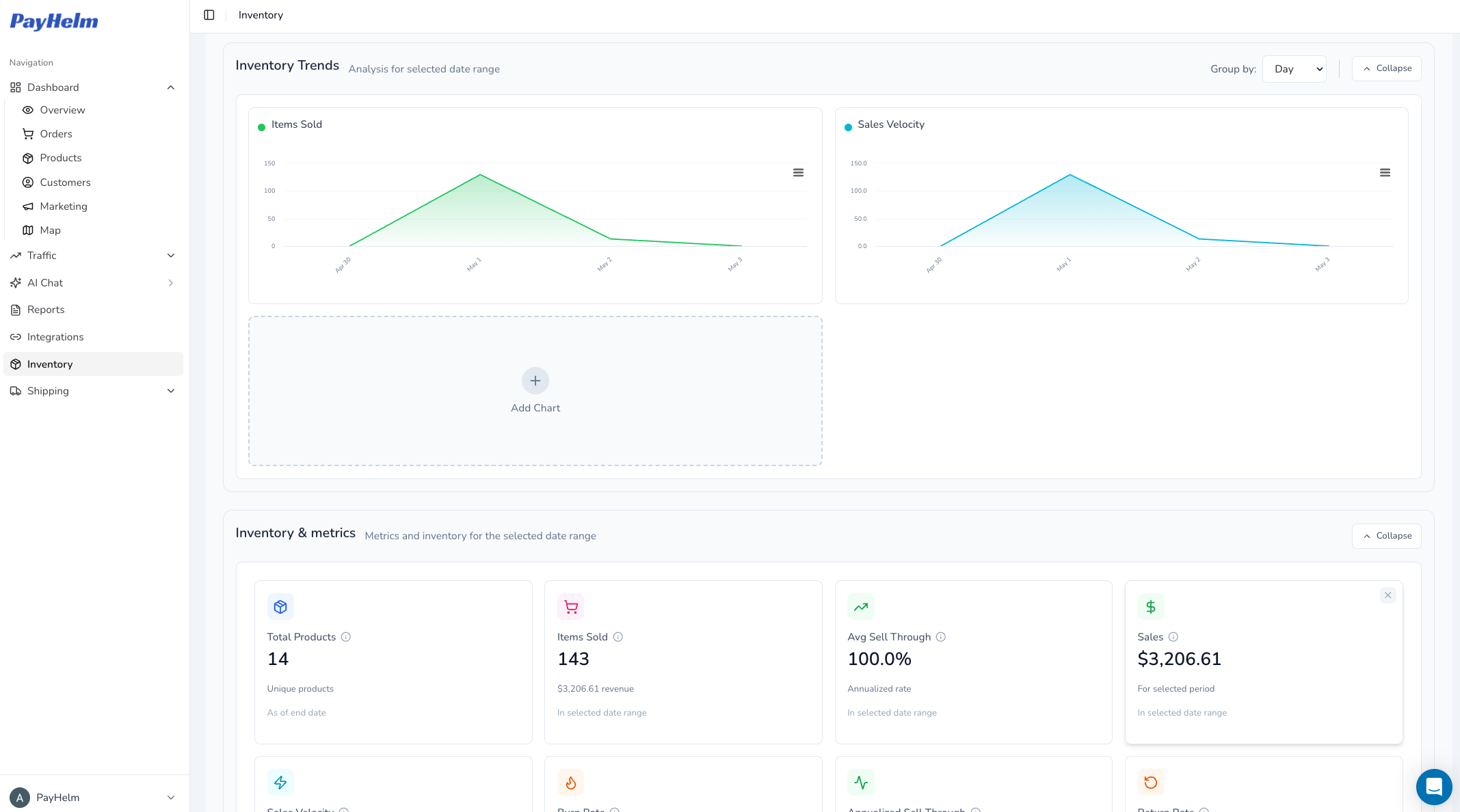
PayHelm combines inventory levels, depletion, and sales velocity to prioritize exposure. Ask, “Which high-revenue products may run out next week, and what should we address first?” Use the answer to plan replenishment. The inventory analytics workspace provides another way to investigate the products behind the forecast.
Ask follow-up questions about lead time, revenue impact, or a particular sales channel to turn the forecast into a buying list. The goal is not to eliminate every risk, but to give the inventory team enough warning to choose the least costly response.
PayHelm is most useful when the question moves from a headline to a decision. Start with the broad result, ask a focused follow-up, and verify the supporting records before acting. That workflow keeps AI-generated analysis practical, transparent, and aligned with the operating team’s judgment. It gives the team a repeatable path from an observation to a responsible operational decision.