
All customer storiesPlatform partnership · October 2024
“We’re thrilled to partner with the PayHelm team to provide merchants with powerful, easy-to-use analytics tools that will help them gain deeper insights into their business”
De Wet HuysamerSenior Director of Strategic Partnerships at Woo, as published with the announcement

WooCommerce × PayHelm

WooCommerce

WooCommerce + PayHelm: clearer data. Better merchant decisions.

A platform partnership built around a familiar ecommerce challenge: connecting store, marketing, payment and operational data so merchants can make reporting work for the decisions ahead.

Automated insights Dozens of sources Customizable reporting

PayHelm analytics

A wider view of the store

Product view
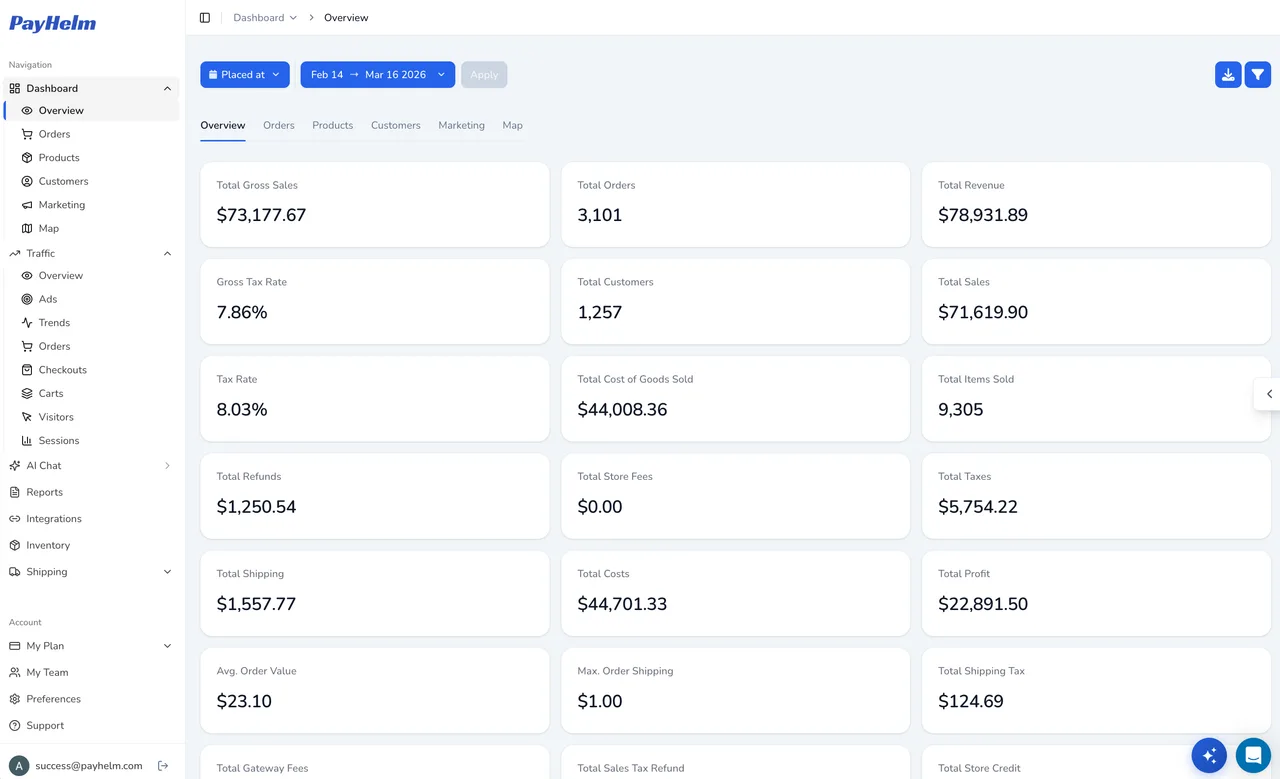
PayHelm analytics dashboard product interface

Store sales

Operations

Growth channels

Product imagery, not a WooCommerce merchant result.

Announced on October 8, 2024, this platform partnership brought together WooCommerce’s merchant ecosystem and PayHelm’s reporting expertise, with a shared goal: help store owners turn their data into better-informed decisions.

View in WooCommerce Marketplace

A closer look

From scattered signals to a more useful point of view.

The partnership announcement points to a practical ambition: give merchants a way to connect the information they already rely on with the questions they need to answer.

01

The everyday friction

A store runs on many systems. A decision rarely fits inside one.

An ecommerce team can have a storefront full of orders, an advertising account full of spend, a payment provider full of transactions and a marketing platform full of customer activity. Each system describes a real part of the business. None, by itself, necessarily answers the question a merchant is trying to resolve.

A week that looks strong in one report may carry a different story in another. Sales can be rising while logistics costs shift. A campaign can attract attention while the products it promotes move at different rates. A payment total may need to be understood alongside order timing, refunds or the sales period being reviewed. When the evidence is scattered, people end up copying figures between tabs, checking definitions and rebuilding the same context for each conversation.

That work is more than a nuisance. It makes reporting feel like a destination in its own right: collect the numbers, reconcile them, present them, then hope there is time left to act. The more tools a team uses, the easier it is for the question to get lost in the mechanics of finding an answer.

02

The partnership

Bring the view together, then make it useful to the person asking.

The WooCommerce and PayHelm partnership was announced as a way to help merchants work with store data through automated reporting and insights. The announcement described customized insights drawing on dozens of sources, connecting the store picture with areas such as logistics, tax, inventory and marketing performance.

That framing matters: the value is not simply having another dashboard to check. It is the possibility of bringing related information into a reporting layer where a merchant can examine a question with more of its surrounding context. The store remains the center of the story, while the signals around it help make a report more relevant to the decision at hand.

At the time of the announcement, the offering included more than 300 prebuilt reports, alongside customizable reporting. The breadth gives merchants a starting point; customization gives them room to choose what deserves attention, how information is arranged and which recurring questions merit a dependable view. A report should serve the work, not ask the work to conform to a fixed template.

03

From reporting to operations

A clear answer is only useful when it travels to the next decision.

For an owner, that might mean looking at sales with the practical considerations that sit behind them: what is available to sell, what needs replenishing, how tax affects the picture and what it takes to get an order delivered. For a marketing lead, the more useful view may put campaign activity near store sales, so spend can be considered in the context of what customers actually bought. The intent is to make those conversations easier to ground in shared information—not to promise that any one report settles attribution or proves causation.

Payments add another perspective. A payment platform and a storefront may describe related activity in different ways, and understanding the relationship can make a review less fragmented. The announcement named Google Ads, PayPal and Klaviyo among the integrations. With relevant sources available in one reporting environment, teams can explore how commercial activity overlaps without treating each platform's numbers as interchangeable.

The same principle applies to product and customer questions. A merchant may want to compare product movement, understand patterns across customer activity or see how a change in promotion aligns with store performance. Bringing those signals into a report can provide a more useful place to investigate. It does not remove the need for judgment; it can give judgment a better-organized starting point.

04

Designed around the question

Customization turns a library of data into a working point of view.

Prebuilt reports can shorten the distance between connecting a source and asking a first question. But a finance team, an operator and a marketing team do not always need the same detail or language. Useful reporting leaves room to shape the view around a role, a review cadence and the decisions that person is responsible for making.

A customizable report can help a team focus on a specific slice of its operation, keep the most relevant context together and revisit a familiar question without rebuilding the analysis every time. A recurring review becomes less about searching for the right export and more about interpreting what has changed. Teams can also use a shared report as a common reference point, making it easier to discuss what is known, what needs checking and what action comes next.

That distinction is especially important in a growing store. New products, new campaigns and new operational requirements can create more questions faster than a fixed set of dashboards can answer them. A flexible reporting approach offers a way to adjust the view as priorities shift—while leaving the merchant in control of the decisions and the meaning attached to the data.

05

A shared language

When teams start from the same view, conversations can move forward.

Store performance is rarely owned by one person. Finance may be checking margins and settlement patterns; marketing may be weighing spend against sales; operations may be planning around inventory and fulfillment. Each team sees a different part of the system, but the customer experiences all of it as one store.

A common reporting layer can make it easier to bring those perspectives into the same conversation. Rather than circulating separate screenshots or reconciling slightly different exports in a meeting, colleagues have the opportunity to refer to a consistent, tailored view. The benefit is not automatic alignment or a guaranteed outcome. It is a more practical starting place for asking precise questions together and deciding what should be investigated next.

This is the promise behind reporting that connects ecommerce data to everyday work: less energy spent assembling context, more attention available for the operational choice in front of the team. The best report is not the one with the most charts. It is the one that helps its reader see what matters, understand what remains uncertain and choose a sensible next step.

De Wet Huysamer, in his own words

A shared belief in making store data actionable.

These statements were published with the partnership announcement on October 8, 2024.

“This collaboration aligns perfectly with our efforts to help businesses unlock the power of their data to grow sales, tap into new customers, and improve overall efficiency.”

De Wet Huysamer

Senior Director of Strategic Partnerships at Woo

A reporting layer, not another silo

See the store in the context of the work around it.

The announcement describes a reporting approach that can bring sales and operational context into closer view. Explore the integration and reporting capabilities for details on how PayHelm can support your own questions.

PayHelm analytics

A product view of ecommerce reporting

PayHelm analytics dashboard product interface

PayHelm product imagery; shown as a product overview, not a WooCommerce merchant result.

Make reporting fit your store

Bring your next data question to PayHelm.

Explore the WooCommerce integration, build a report around the way your team works, or talk with us about your reporting needs.